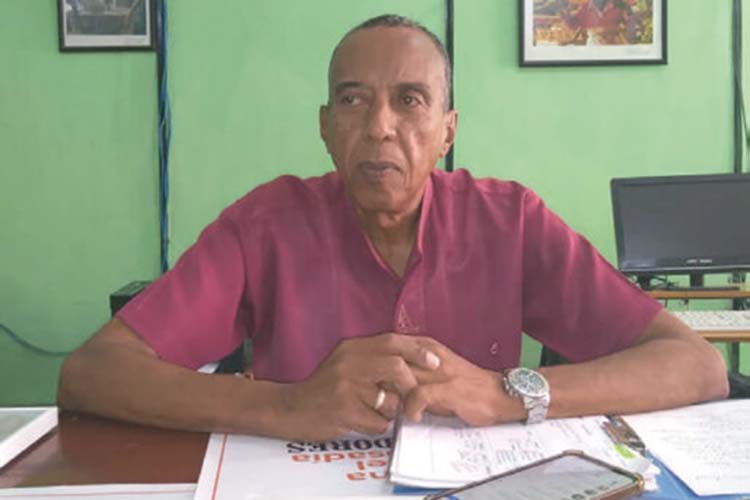
With a punctuality that is not common, Ernesto Freire Casañas arrived. More than an interview, as he admitted at the end, it was like rewinding the clock — flashes that revived over 30 years linked to the trade union movement and to many people who left their mark on him personally, professionally, and politically.
He believed he was destined to follow a working life without many ups and downs after his time at the Camilo Cienfuegos Military School, in the former Havana municipality of Baracoa. From there, he was assigned to the Academy of the Revolutionary Armed Forces (FAR, in Spanish) to oversee the Organization of Work and Salaries (OTS).
Graduating as an industrial engineer from CUJAE seemed enough to secure his place in the specialty he still enjoys. But the change began even before finishing university. First, he became a member of the National Union of Civilian Workers of the FAR (later of Defense). Who could have guessed that his knowledge in applying business improvement within that armed institution would lead him to a bond he still maintains with the Workers’ Central Union of Cuba (CTC)?
“I never thought I’d be a union leader,” he confessed. Events unfolded unstoppably from 1990 until 2006: he held at different times the highest leadership of the Communications Union and the general secretariat of the CTC in Havana and Ciudad de La Habana.
“I accumulated 11 years between those two positions. In the midst of the many tasks they entailed, I was appointed president of the National Nominations Commission for the general elections of 1997–1998 and 2002–2003. A tremendous learning experience, just like the 12 years I was a member of the Party’s Central Committee.
“To meet Fidel? That was a great privilege. I always admired his vision of the future, his strong character, and at the same time his constant concern for the most vulnerable, for creating or revitalizing programs aimed at shaping the new man and woman. Whether it was student work brigades or social workers… It was the era of the Battle of Ideas. I experienced all those tasks thanks to being part of the trade union movement.”
His first congress? “The 17th. These events always leave experiences. How they are organized, how they develop from the grassroots with the culmination in the final sessions. They mark the end of a period of work in which progress, setbacks, and contributions within the structures of the CTC, its unions, and the innovators and rationalizers are evaluated.
“What do I think of trade union work? That it materializes at the grassroots, with the important mission of organizing, training, mobilizing workers, and representing them well before administrations. And for that, one must be well prepared.”
Such reflections bring to mind Ramón Cardona Nuevo, Ángel Luis Mena Kindelán, and Lázara Silvia Santiago Rodríguez — experienced union leaders now deceased.
“The rich history of Ángel and Lázara culminated in their strong work within the Retirees and Pensioners Movement at the national CTC and in Havana, respectively. I succeeded Ramonín in the role of heading the World Federation of Trade Unions for Latin America and the Caribbean, a position I hold and never imagined I would.
“I apply my experiences and the conviction that one must contribute as much as possible wherever one is. International relations are important, and Cuba, the CTC, have strong support from trade union organizations across the globe. The most recent examples were seen in the May Day activities, and we confirmed it in the solidarity campaigns we are infinitely grateful for. It is another satisfaction I feel thanks to that day, more than 30 years ago, when I joined the trade union movement.”

Fundación Robert A. Paneque