In the current circumstances, the training of union leaders is an unavoidable necessity. The complex scenario the country faces, the economic and social transformations promoted by the Government, and the approval of the new Labor Code demand union leaders with greater legal, political, and economic preparation, capable of adequately representing workers’ interests and contributing to finding solutions to problems that arise in each workplace.
That is why training must be a permanent and systematic process, linked to the reality of each center. A union leader must master labor legislation, but also ensure it is properly applied in real situations.
We know that the economic and social difficulties derived from the U.S. blockade directly affect workplaces. Problems related to workers’ purchasing power, transportation, resource availability, and work organization are increasing, among others that may be subject to constant analysis and concern.
Therefore, in this context, leaders must be able to listen to and channel workers’ concerns. They should not minimize any complaint or issue, nor respond hastily, and even less ignore those concerns. They need to identify causes, distinguish individual from collective problems, and determine what should be solved by the union, by management, or through established procedures.
They must be prepared, among other aspects, in workers’ and employers’ rights and duties; labor discipline, collective participation, contracts, working hours and rest; wages, payment systems, disciplinary regulations, conflict resolution, workplace safety and health, functions of union organizations, and new forms of management and employment.
Union credibility is built when workers perceive that their concerns are heard and receive a definitive response or solution. A union leader must develop skills to analyze conflicts, argue, negotiate, mediate, build consensus, and find solutions.
The economic and social transformations in Cuba’s economy make it essential for our leaders to understand the changing, diverse labor landscape, which includes labor relations with state enterprises, budgeted institutions, self-employed workers, MSMEs, cooperatives, and other forms of management. Hence, union training must be updated at the same pace as the labor world.
There are practical tools to develop such training. Debates, brief presentations, case studies, interpretation exercises, practical evaluations, analysis of real conflicts, and the well-known conferences should be combined.
An example would be presenting a situation in which a worker feels their right has been violated and asking the leader to determine the problem, the applicable regulation, the necessary documentation, the procedure, the responsibilities of each party, and the follow-up mechanism.
The purpose cannot be training for training’s sake, but transforming the quality of union work.
The indicator for measuring effectiveness in this matter should not be how many union leaders attended, but how union functioning has been transformed in the workplace, although we still lack measurable indicators to evaluate its performance.
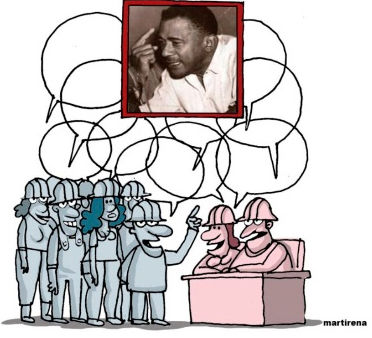
We reiterate: the training of union leaders under Cuba’s current conditions is a strategic priority, an obligation to strengthen the work of unions, the Workers’ Central Union of Cuba, and labor relations. Those of us with the mission to represent, guide, and accompany workers must be better prepared in every sense. This is also a legacy from Lázaro Peña and Fidel. And as good heirs, it is our duty to follow their example creatively and without ever renouncing what has been achieved.
* Second Secretary of the CTC